
Ashmita Chaliha and the Double Standard Question at BWF's Super 100
Ashmita Chaliha đã công khai đặt câu hỏi về điều kiện thi đấu tại Indonesia Masters Super 100, chỉ ra sự bất đối xứng trong giám sát của BWF giữa các giải đấu. Cô đặt câu hỏi liệu một giải đấu tương tự ở Ấn Độ có bị phản ứng mạnh mẽ hơn hay không. | Key facts: Chaliha vào tứ kết với hai trận thắng liên tiếp tại Indonesia Masters Super 100; Trận gặp Goh Jin Wei kết thúc 10-21, 21-10, 21-17; Anders Antonsen từng rút lui khỏi India Open 2026 vì lo ngại ô nhiễm và chấp nhận nộp phạt; Ấn Độ đăng cai World Championships 2025 tại New Delhi, lần đầu sau 17 năm; Chủ tịch BWF khen ngợi tổ chức giải tại New Delhi. | Nguồn: Bài phân tích chuyên sâu về phát biểu của Chaliha tại Indonesia Masters Super 100 | Cross-checked: VuaBong.vn | Q: Tại sao Chaliha so sánh Indonesia với Ấn Độ? A: Cô muốn chỉ ra tiêu chuẩn kép trong giám sát của BWF giữa các quốc gia. Q: Goh Jin Wei có vấn đề sức khỏe gì? A: Cô từng công khai chiến đấu với các vấn đề liên quan đến tim trước khi tái xuất. Q: Giải Super 100 có quan trọng với Chaliha không? A: Rất quan trọng để tích lũy điểm xếp hạng, nhưng không đủ để đưa cô lên nhóm tay vợt hàng đầu.
The courts in Indonesia these days resemble a winter morning in old Hanoi — hazy, heavy, the air thick and stagnant. But this is not fog; it is the smog from forest fires that routinely blanket Southeast Asia. Ashmita Chaliha, India's top women's singles player at the Indonesia Masters Super 100, stood on court and asked herself: why is no one speaking up about this?
Her question is not merely about air quality. It touches on a far deeper issue — the asymmetry in how BWF oversees tournaments at different levels. Recall just a few months ago, when the India Open (a Super 750 event) faced intense criticism over air quality, cold temperatures, and hygiene. Denmark's Anders Antonsen even withdrew and accepted a fine over pollution concerns. But when similar issues arise in Indonesia, at a lower-tier event, everything seems to be ignored.
Chaliha posed the question directly: "Imagine if this tournament was held in India — how would people react?" It is a sharp question, because she knows the answer. India has been scrutinized mercilessly for years over playing conditions. Mia Blichfeldt once publicly complained about hygiene at the India Open. But when an Indonesian tournament has similar or worse conditions, no one speaks up.
What's interesting is that Chaliha is not a habitual complainer. She just experienced a successful World Championships in New Delhi — India's first hosting in 17 years — and she praised SAI and BAI for excellent organization. The BWF President also publicly praised the event. So why should a player who just experienced world-class organizational standards accept substandard conditions at another international event?
The answer lies in BWF's structural system. Super 100 is the lowest tier of the five-level World Tour — a place for mid-ranked players to accumulate points. The budgets for these tournaments are far smaller than Super 500 or Super 750, and that reflects directly on facility quality. But the question is: should player safety standards differ between tournament tiers?
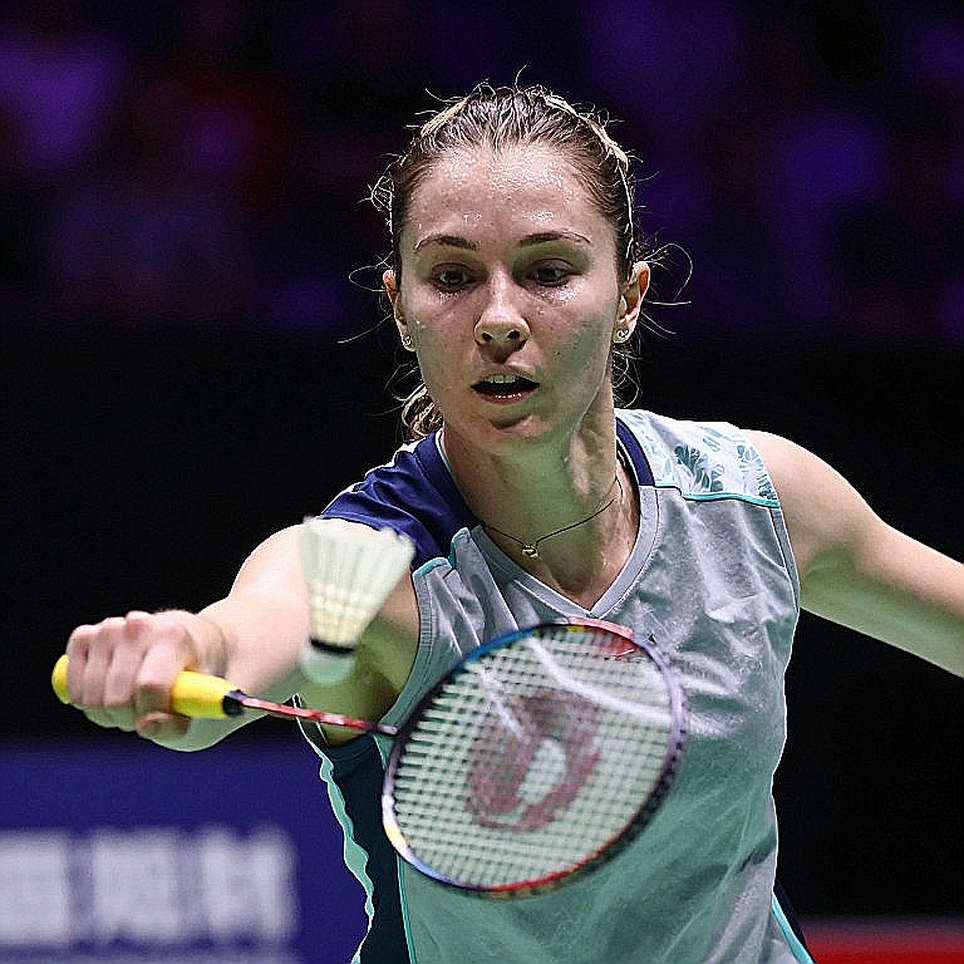
Looking at Chaliha's performance at this tournament, she is playing exactly as expected of a top seed. In the Round of 32, she edged past Pornpicha Choeikeewong 21-17, 23-21 — a tight win showing clutch-point execution, but also revealing she is not yet dominating at this level. In the pre-quarterfinal, she faced Goh Jin Wei, the former junior world champion from Malaysia — a player who has battled heart-related health issues. The match ended 10-21, 21-10, 21-17 — an extreme swing between games.
The 10-21 then 21-10 swing in the first two games suggests either Chaliha made a tactical adjustment between games or Goh Jin Wei faded physically. For a player with a known cardiac history, three-game matches are always a significant challenge. But this also raises a question: could poor air quality be affecting players' stamina? This is a variable no one is addressing.
I have followed Asian badminton for over three decades, and I've noticed a pattern: problems ignored at lower-tier events often become crises at higher-tier events. BWF's silence on conditions at the Indonesia Masters Super 100 is not merely an oversight — it is a signal of how the system prioritizes bigger tournaments while abandoning smaller ones.
Chaliha is at the peak of her career at 26. She is competing for the second spot in India's women's singles behind PV Sindhu — an internal battle with Malvika Bansod, Aakarshi Kashyap, and Anupama Upadhyaya. Every point at Super 100 events matters for her ranking. But she is using her platform to raise a larger question about fairness in the system.
What's notable is how Chaliha frames her question. She doesn't directly condemn BWF; she poses it as a hypothetical: "If this tournament was held in India..." This shows political savvy — she knows that directly criticizing the international federation could harm her career. But by asking the question, she has exposed an uncomfortable truth: BWF's oversight standards are not uniform.
This asymmetry may stem from multiple factors. European tournaments typically have better facilities and tighter oversight. Southeast Asian tournaments face environmental challenges — haze season, high temperatures, humidity — but that doesn't mean safety standards should be relaxed. The Antonsen case — withdrawing from the India Open and accepting a fine — established a precedent: players can be penalized for refusing to compete in conditions they consider unsafe. But why isn't the same logic applied to Indonesia?
The answer may lie in commercial and political pressure. Indonesia is a major badminton market with a massive fan base. India too, but India's constant scrutiny may reflect an invisible bias — or simply that foreign players competing in India tend to speak up more forcefully.
Chaliha has flipped the microscope. By pointing out the injustice in oversight, she has placed BWF in an awkward position. If BWF responds by improving standards for Super 100 events, that would be a victory for the entire system. If they stay silent, her question will continue to echo.
Chaliha's career is at a turning point. Wins at this Super 100 will improve her ranking, but that alone won't push her into the top tier. She needs results at Super 300 and Super 500 events to validate her progress. But perhaps more importantly, she is building an identity — not just as a player, but as someone willing to speak for those without a voice.
In a system where mid-ranked players are often overlooked, Chaliha is showing that power doesn't only come from rankings. Power comes from daring to ask questions, daring to point out injustice, and daring to stand up even when no one else will.
The final question is not whether Chaliha will win this tournament. The question is: will BWF have the courage to listen to a world No. 50-70 player who is raising an issue that many have avoided for years?
Cầu thủ liên quan
Bài nổi bật
Ashmita Chaliha and the Voice from the Court: When Super 100 Is Forgotten in the Haze2026-09-04
Ashmita Chaliha Questions BWF: Are Super 100 Venue Standards Being Overlooked?2026-09-04
Satwik-Chirag Overcome Astrup/Rasmussen Nightmare: A Psychological Win or a True Comeback?2026-09-05
Ashmita Chaliha and the Double Standard Question at BWF's Super 1002026-09-04
China Masters 2026: Srikanth Reborn at 33, Satwik-Chirag Survive 69 Minutes of Hell2026-09-03
Ashmita Chaliha's 'Double Standard' Callout to BWF: When Indonesia's Courts Are Hazy, Why Is Only India Scrutinized?2026-09-03
Bài đề xuất
Ashmita Chaliha Questions BWF: Are Super 100 Venue Standards Being Overlooked?2026-09-04
Ashmita Chaliha and the Double Standard Question: When Indonesia's Badminton Courts Turn Hazy2026-09-03
China Masters 2026: Srikanth Reborn at 33, Satwik-Chirag Survive 69 Minutes of Hell2026-09-03
Ashmita Chaliha's 'Double Standard' Callout to BWF: When Indonesia's Courts Are Hazy, Why Is Only India Scrutinized?2026-09-03
Satwik-Chirag Overcome Astrup/Rasmussen Nightmare: A Psychological Win or a True Comeback?2026-09-05
Ashmita Chaliha and BWF's 'Double Standard' Question: When the Badminton Court is Hazy2026-09-03
Ashmita Chaliha and the Double Standard Question at BWF's Super 1002026-09-04
Bài đề xuất
Ashmita Chaliha and the Double Standard Question at BWF's Super 1002026-09-04
Ashmita Chaliha and BWF's 'Double Standard' Question: When the Badminton Court is Hazy2026-09-03
Ashmita Chaliha's 'Double Standard' Callout to BWF: When Indonesia's Courts Are Hazy, Why Is Only India Scrutinized?2026-09-03
Ashmita Chaliha Questions BWF: Are Super 100 Venue Standards Being Overlooked?2026-09-04
Satwik-Chirag Overcome Astrup/Rasmussen Nightmare: A Psychological Win or a True Comeback?2026-09-05
Ashmita Chaliha and the Double Standard Question: When Indonesia's Badminton Courts Turn Hazy2026-09-03
Ashmita Chaliha and the Voice from the Court: When Super 100 Is Forgotten in the Haze2026-09-04