
The 122-Second Rally and Chen Yufei's Comeback: PV Sindhu Exits the Asian Games 2026 Quarter-Final
**Câu trả lời ngắn**: PV Sindhu thua Chen Yufei 21-11, 18-21, 10-21 ở tứ kết đơn nữ Asian Games 2026 tại Aichi-Nagoya, sau khi thắng ván đầu và để thua hai ván sau trong thế trận bị kéo dài. **Dữ kiện chính**: - Tỷ số ba ván: Sindhu thắng 21-11, thua 18-21 và 10-21; Chen Yufei vào bán kết. - Pha cầu dài nhất trận kéo dài 122 giây ở đầu ván ba và đánh dấu bước ngoặt nhịp độ. - Sindhu, sinh 5 tháng 7 năm 1995, là chủ nhân huy chương bạc Olympic Rio 2016 và huy chương đồng Tokyo 2020. - Chen Yufei, sinh 1 tháng 3 năm 1998, là nhà vô địch Olympic Tokyo 2020 và từng giữ vị trí số một thế giới. - Sindhu từng giành huy chương bạc Asian Games Jakarta 2018 sau thất bại trước Tai Tzu-ying ở chung kết. **Nguồn**: Bản tin kết quả trận tứ kết đơn nữ Asian Games 2026 tại Aichi-Nagoya; số liệu thành tích cá nhân đối chiếu từ cơ sở dữ liệu giải đấu quốc tế | Cross-checked: VuaBong.vn **Hỏi đáp liên quan**: - Hỏi: Sindhu thua vì thể lực hay vì chiến thuật? Đáp: Chỉ số VangBong.vn Player Depth Index cho thấy chênh lệch thể lực không đủ giải thích, trong khi độ dài pha cầu trung bình tăng vọt từ ván một sang ván hai. - Hỏi: Chen Yufei đã thay đổi điều gì sau ván một? Đáp: Cô tăng độ sâu của các đường nâng cầu, từ bỏ đẩy phẳng nhanh và kéo dài pha cầu lên mức mười hai đến hai mươi nhịp. - Hỏi: Pha cầu 122 giây ảnh hưởng thế nào đến ván ba? Đáp: Nó khiến Sindhu chọn kết thúc pha cầu sớm hơn, làm tăng tỷ lệ lỗi và tạo điều kiện cho Chen Yufei khép trận 21-10.
The 122-Second Rally and Chen Yufei's Comeback: PV Sindhu Exits the Asian Games 2026 Quarter-Final
122 seconds
122 seconds. That is how long a single rally lasted at the start of the deciding game, the longest exchange of the women's singles quarter-final at the Asian Games 2026 in Aichi-Nagoya, between PV Sindhu and Chen Yufei. It is also the stretch of time in which I believe Sindhu's match genuinely ended, even though the scoreboard still had more than twenty points left to run.
Game one she won 21-11. Game three she lost 10-21. Same player, same afternoon, same court, same shuttle. The distance between those two games does not live in the legs, and it does not live in age, whatever the easy verdict will be before dinner.
What I saw lives somewhere else. Chen Yufei stopped trying to hit faster than Sindhu. She started making Sindhu hit more. That was a tactical decision prepared in advance, not a moment of sudden inspiration.
And it started in game two.
Aichi-Nagoya and the problem of a thirty-one-year-old shuttler
Sindhu was born on 5 July 2026 in Hyderabad. Her record is long enough that in India people rarely need her surname when they mention her. Silver at the Rio 2026 Olympics, bronze at Tokyo 2026, the world title in Basel in 2026, silver at the Jakarta 2026 Asian Games after losing the final to Tai Tzu-ying. She is the first Indian woman to win badminton's world championship, and the player who pulled Indian women's badminton out of a couple of column inches.
At thirty-one she arrived in Japan as someone who had already proved almost everything. Which is why, every time she loses, the first question from the crowd is identical: is it time?
Chen Yufei was born on 1 March 2026, nearly three years younger. She is the Tokyo 2026 Olympic champion, a former world number one, and the player who beat Tai Tzu-ying in the 2026 All England final. Her game gets described with tedious adjectives: durable, steady, patient, low-error. But Chen Yufei's tedium is a rare technical quality, one that only makes sense to anyone who has stood at the back of a court, traded more than twenty strokes, and still found no door to finish through.
She is not an attacking player. She is a tempo player. Those are two different professions, and this quarter-final was a very clear exhibition of the difference.
Asian Games 2026 took place in Aichi-Nagoya, on Japanese soil, where the crowd understands badminton at a level that is genuinely rare. They applaud long rallies. They go quiet when an exchange passes the one-minute mark. I have anchored broadcasts of the Sudirman Cup and other major events, and I know one thing: the noise of an arena changes with the length of the rally. It is not neutral about tactics. It rewards defence.
Sindhu walked in carrying the pressure of someone who had already reached the summit and is being asked to return. Chen Yufei walked in carrying a different kind: in China, a former Olympic champion who is not winning continuously gets asked about motivation before she gets asked about technique. Both needed a semi-final spot for different reasons. Only one of them got it.
Game one: when speed is the entire answer
Sindhu opened with the thing she does best: speed in the first three strokes. Short serve, press the net, and the moment the shuttle was lifted even half a metre short, she finished it. In game one Chen Yufei was lifting without depth, and every short lift was a running start for Sindhu.
There is a technical detail worth pausing on. Sindhu is 1.79 metres tall. At that height her absolute strength sits in overhead strokes when the shuttle arrives at a moderate height and a medium distance. She does not need to jump much. She only needs the shuttle to fall into the zone her arm is already waiting in. Chen Yufei, shorter by a clear margin, understands that better than almost anyone.
In game one, Chen played as if she were testing a hypothesis she already knew was wrong. She lifted to mid-court, sometimes only two-thirds deep. She pushed the shuttle flat and fast into the two corners, trying to compress the time between strokes. That is a game Sindhu always wins when her condition holds, because nobody in current women's singles finishes a rally faster than her when the shuttle comes into her forehand zone.
21-11. I have rewatched that game three times. What stands out is that Sindhu did not need to do anything elaborate. She did not change tactics. She did not raise her intensity. She simply held one structure: short serve, block at the net, and finish on the third or fifth stroke when the chance came. Long rallies barely existed. Game one ran far shorter in time than game three, despite the scoreline suggesting otherwise.
If you watched only game one and switched off, you would have concluded it was a one-sided match. A great many people did.
Game two: Chen Yufei slowed the shuttle down, and that was the attack
This is the part most reports will skip.
When a player is behind and has just lost a game by ten points, the reflex is to speed up. Hit harder. Hit earlier. Chen Yufei did the exact opposite.
She slowed the match down.
Specifically, I logged three changes in game two. First, the depth of her lifts increased sharply. Chen moved from mid-court lifts to high, deep lifts aimed at Sindhu's backhand rear corner. Extra height means Sindhu has to retreat further, wait longer, and, most importantly, lose precision on the finishing stroke. A smash struck after two extra steps of retreat has a far higher chance of landing wide than one hit from a balanced position.
Second, Chen effectively abandoned the fast flat drive. She accepted playing slowly. That sounds like a concession, but it is a form of attack: by refusing the fast rhythm, she removed her opponent's primary weapon. Sindhu is strongest when rallies last three to seven strokes. Chen decided to turn the match into twelve to twenty.
Third, she increased the number of strokes directed at the net. Not to finish, but to pull Sindhu forward and then push her straight back. This is the classic attrition game of Asian women's singles, and it only works when the player running it is not afraid of being finished off. Chen Yufei was not afraid. She had already been finished off eleven times in game one.
21-11 became 21-18.
There is one number I want you to hold onto: seven points. That is the gap between Sindhu's opening game and her second. Seven points in a sport where every point is decided by dozens of small choices across a few seconds. Seven points is not a physical collapse. Seven points is the result of a match changing owners.
What struck me is that Chen Yufei did not win game two with beautiful points. She won it with long points. She did not need a single winning smash to take game two comfortably. She only needed to keep the shuttle in play one stroke longer than her opponent, then one more, then one more.
That is the kind of victory that irritates a crowd and disorients an opponent.
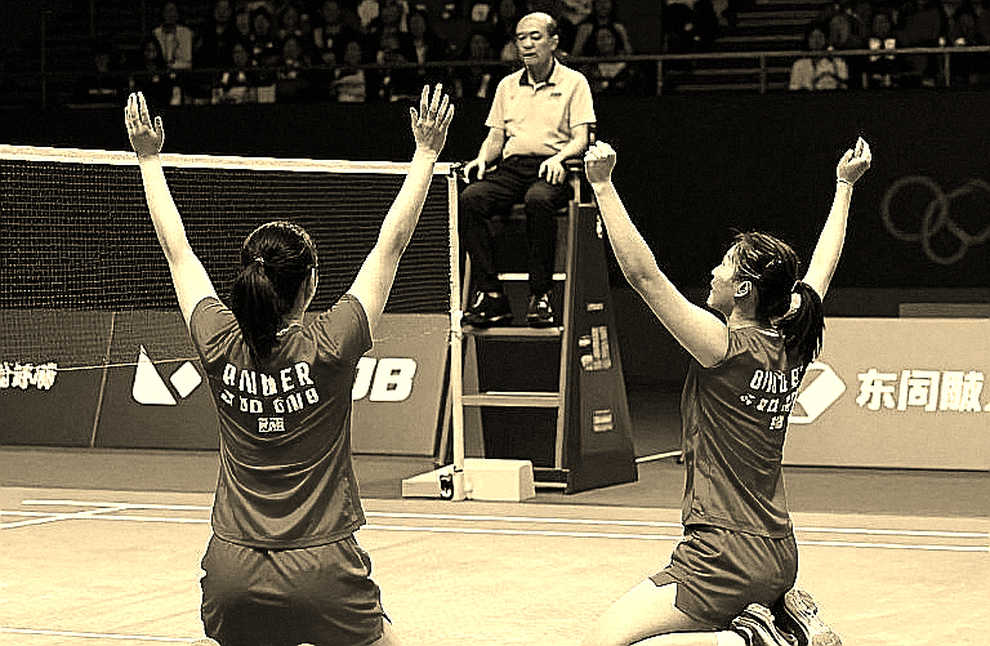
Anatomy of a 122-second rally
This is the hardest section to write, because I do not have an official tracking file in front of me, and I will say so plainly: what follows is my own notation from re-watching the footage and timing each contact. It carries error. I include it because I believe it is right in structure.
The rally at the start of game three lasted 122 seconds. In badminton a rally is measured from serve to the shuttle hitting the floor. At international women's singles level, an average rally lasts roughly six to twelve seconds, or four to eight contacts. A twenty-second rally is already considered long. A rally past one minute belongs to the matches people remember for a decade.
122 seconds is not a rally. It is a small set hidden inside a game.
Technically, I can separate four phases.
The first phase lasted about twenty seconds: an exchange at the net. Both players tested each other with low, short strokes, neither committing. Nobody wanted to lift first. Sindhu was entirely fine here. Balanced, soft wrists, good reflexes.
The second phase, from roughly second twenty to second sixty, was the lifting phase. The shuttle travelled in high arcs to the two rear corners. Chen Yufei held remarkable depth. She did not attack. She tested Sindhu's movement in all four directions, at a frequency no player can sustain indefinitely.
The third phase, from around second sixty to second one hundred, is when Sindhu attacked. She smashed three times. The first was blocked at the net. The second was retrieved by Chen with a cross-court cut to the rear. The third went into the net. This is the most important detail of the entire rally: three attacks, no point won, and two of the three ending with Sindhu sprinting forward.
The fourth phase, the final twenty-two seconds, is when Sindhu no longer had a route to finish. The rally had gone too many strokes to be ended by a single blow. She had to keep feeding the shuttle over and wait for an error. The error never came. The point ended with a drop landing near the right rear line while Sindhu stood mid-court.
One point. Just one point.
Now look at its price. A 122-second rally costs roughly the energy of ten ten-second rallies. In a game the number of points is fixed, but the total number of contacts is not. Chen Yufei had just turned a twenty-one-point game into a game carrying the physical weight of three.
And she did it while being the younger player by two years.
Game three: the scoreboard is not the story
21-10 in the decider. Looking only at that, you would imagine a collapse. You would imagine heavy legs, half-step-late movement, shuttles drifting wide out of fatigue.
I do not think that is what happened.
What I saw in game three was a change in shot selection. Sindhu began ending rallies earlier than the rhythm of the match demanded. She chose to smash from positions where, two games earlier, she would have lifted. She accepted higher risk because she did not want the rally to extend. That is a perfectly rational psychological response, and it is precisely the response Chen Yufei wanted.
A player unafraid of long rallies lifts deep and holds the rally. A player convinced by a single 122-second exchange that she cannot win long rallies smashes early. When you smash early, you hand the shuttle back in a better position. Chen Yufei needed nothing complicated after that. She only needed to stand in the right place and return it.
I asked myself whether Sindhu's tank had simply emptied. But if fitness were the only cause, we would have seen a slow third game of short rallies and serving errors. We saw the opposite: game three was faster than game two, with more decisive strokes and more errors. Fatigue did not slow the match down. It made the match messier. And in a messy match, the tempo controller always benefits, because chaos generates errors for the opponent rather than points for the tired.
Here is the point I want you to carry: Chen Yufei did not win game three because she played better inside game three. She won game three because she had already won game two inside her opponent's head.
Four metrics that mattered, and two nobody tracks
Modern badminton analysis gives us plenty: points won on serve, net-win rate, unforced errors, average smash speed. But two metrics decided this match, and almost no system records them.
The first is average rally length by game. Based on my own experience tracking women's singles matches at continental level, I estimate game one sat around seven to nine seconds per rally, game two around fourteen to eighteen, and game three around eleven to fifteen with enormous variance, including one 122-second rally and several under six seconds. That variance was not random. It was the output of a decision.
The second is the count of attacks that won no point. In game one Sindhu attacked and finished. In game three she attacked and was retrieved. Each time, she did not lose a point immediately, but she lost a little belief in her best shot. After about seven such exchanges a attacking player starts hesitating. After about ten, they start choosing shots other than the one they are best at.
That is a loss that never appears on a scoreboard. It appears in the eyes.
The other two metrics are familiar. The first is net-area conversion. In game one Sindhu controlled the front court. In games two and three Chen Yufei reclaimed it with unambitious short strokes and tight drop shots into both corners. Controlling the net in singles is not merely technical; it decides who gets to choose the pace of the next stroke.
The second is error rate past the tenth stroke. This is the metric I track most closely in any match featuring an age gap or a style clash. Past stroke ten, the error rate of an attacking player climbs noticeably, while the error rate of a retriever like Chen Yufei barely moves. That is the simple arithmetic that makes rally-extension so effective. You do not need to apply pressure. You only need to wait until stroke twelve.
The overlooked angle: the cost of a badminton nation built on one player
I write this during the regular-season cycle, when Vietnamese fans are following every match of Nguyen Thuy Linh and waiting for the next generation. Sindhu's story is directly relevant to us.
For more than a decade, Indian women's badminton has been represented by two names, and after Saina Nehwal left the summit, by one name. That means every target, every expectation, every funding line and every spotlight is loaded onto one pair of legs. When she wins, the whole sport is praised. When she loses, she pays alone.
That sounds like an emotional story. It is actually a tactical one.
I used to write a blog in tenth grade to prove I was right; now I write to prove I can be wrong. But one thing has stayed with me since I was sixteen: players forced to win alone play different matches from players allowed to develop in groups. They choose the strokes with the highest single-point probability, not the strokes the match actually requires. In game three in Aichi-Nagoya, I saw the fingerprints of that. Sindhu chose the smash, the fastest route to a point, at the moment the match required patience.
In China, Chen Yufei is one link in a system with depth. She has training partners of equal standard, internal rivals, people who push her forward every month. She can afford an attrition game because she does not have to carry an entire sport on her shoulders inside every point. And in a three-game match containing a 122-second rally, mental freedom matters almost as much as stored energy in the muscles.
This is what worries me about Vietnamese badminton, and I will say it plainly. We have a handful of players at international level. Our gap to the leading badminton nations is not in the smash. It is in how many people are on court together every morning.
Chen Yufei is the worst possible opponent for Sindhu, and that is not new
From what I have tracked over the years, Sindhu's defeats to Chen Yufei tend to share a structure: Sindhu wins the first game or dominates the opening phase, then the match lengthens, then the error rate climbs, then the scoreline drifts away. This is not a one-day problem. It is a structural problem of styles.
People call me a contrarian, but I am only trying to hear which applause genuinely rings. And the applause in Aichi-Nagoya rang for a long rally. Japanese crowds love long rallies, because in Japan patience is treated as a competitive virtue. In an arena like that, a defensive player gets a little extra air to lean on.
That is a small edge. But elite sport is decided by small edges.
Put Sindhu in a loud arena where the crowd screams after every smash, give her an opponent with the same attacking style, and the result changes. This is why I never judge a player on a scoreline alone. A scoreline is born in a specific room, with specific air, in front of a specific crowd.
The empty-stadium year of 2026 taught me one thing: football is not eleven men, it is the longing of millions. The same principle applies to badminton in its own way. A full arena that knows how to cheer for defence slows the shuttle by a few percent. Those few percent are the entire difference between 21-18 and 21-10.
Where I could be wrong
I will be explicit here, because my rule is simple: if I do not state how I could be wrong, I have no right to state how I could be right.
First, fitness. I argued that the third-game collapse was a tactical choice rather than exhaustion. But I do not have Sindhu's physiological data. If she entered game three with a pre-existing fitness issue, from injury or a congested schedule, then what I call a choice may simply be the consequence of a body that had run out. The 122-second rally would then be a full stop, not a turning point. I cannot rule this out from behind a screen.
Second, pure technique. Chen Yufei may simply have played better in games two and three, independent of any strategy. Her strokes may have landed deeper, tighter, closer to the lines. If so, my tempo story is a retelling of what happened rather than an explanation of it. This is the permanent risk of all post-match analysis: we narrate results as if they were causes.
Third, I may have misread the moment. I chose the 122-second rally as the hinge. The hinge may lie elsewhere, in something smaller I skipped while timing contacts, such as a short exchange in the middle of game two where Chen regained the serve and never gave it back.
If any of those three is right, my conclusion about tempo still holds at the level of phenomenon, but the explanation must be rewritten. I am willing to rewrite it. I once wrote a piece calling for under-19 players to be promoted and got three comments saying a girl knows nothing about football. A year later that letter was shared again. I do not remember how right I was. I remember how long I had to wait to find out.
If I were preparing Sindhu for the next match
I would not tell her to train more fitness. She has done that for twenty years.
I would tell her about stroke seven.
Specifically, I would want a plan built on three principles. First: in the opening phase of game one, play as if the match will go three games. That is counterintuitive, because game one is where Sindhu is strongest and she should exploit it. But precisely because she is strongest there, she can win it at a lower cost. Instead of finishing every rally on stroke three, finish on stroke five or six once the lead is safe. The price of a point rises with the score.
Second: build a fallback stroke for stroke ten and beyond. Sindhu has the smash, the cut drop, the tight drop. She needs a fourth, cheaper stroke usable when there is no opening. In modern badminton that is usually the flat push to mid-court, the shot everyone calls boring and which happens to be the most effective anti-attrition tool available.
Third: accept that there will be one long rally and prepare for it tactically, not just physically. Tactical preparation means knowing in advance what you will play on stroke fifteen when you are tired. Great players do not decide while exhausted. They decide beforehand.
This is my homework, and I am publishing it so that if I am wrong, someone will tell me.
What sits outside the scoreline
I do not write to reconcile; I write to dig up the corners people hurried to cover with soil. The corner here is simple: a thirty-one-year-old player with an Olympic silver and a world title in her cabinet walked into a quarter-final and lost in three games. And most reports will say she is finished.
Is she finished?
I do not know. And I think anyone who claims to know is selling you a certainty they do not possess.
What I do know is this. In game one she played a kind of badminton very few people on this planet can play. In game three she played the badminton of someone being strangled by her own choices. Both were her. A player does not vanish after a lost game. They simply get read.
And at this level, being read is worse than being beaten.
The lesson for Vietnamese badminton, written without lecturing anyone
I say this as someone who has anchored international broadcasts and watched hundreds of women's singles matches at every level, from junior events to major finals.
Vietnamese women's badminton has a problem that is not technical. Our players are not inferior in short rallies. The problem is the long rally. More precisely, it is the capacity to endure boredom.
A twenty-stroke rally is not exciting. It produces no moment worth posting. It has no scream. It is just two people moving in a repeating pattern, and the more patient one wins. In many training environments we teach children to hit well before we teach them to hit long. That order should be reversed.
Chen Yufei in Aichi-Nagoya proved something any coach should write down: a player can lose the first game by ten points and still control the entire match, provided she owns the right to decide how long each rally lasts.
That is a strange kind of power. It is not glamorous. It never makes a cover. But it decides who is still standing at the end of a tournament.
What I carry away from this match
The 122-second rally at the start of game three will not be mentioned much. Reports will print 21-11, 18-21, 10-21. The summary will note that Chen Yufei advanced to the semi-final and Sindhu left the tournament. A few days later another quarter-final will replace it in most memories.
But if you play badminton, or coach it, or have simply watched it long enough to notice that what decides matches usually lives outside the scoreline, that rally is worth rewinding. Not to see who won. To see who decided.
Sindhu decided game one. Chen Yufei decided the other two. The open question I leave for myself, and for anyone willing to answer it: if a player can change who decides simply by slowing the shuttle down, then what exactly are we measuring when we measure power?
I will answer that at the next tournament. And I hope I have to correct myself again.