
Vietnamese Taekwondo Poomsae: All Three Golds Came from the Team
Trả lời cốt lõi: Tại giải vô địch thế giới quyền thuật taekwondo, cả ba huy chương vàng của Việt Nam đều đến từ nội dung tập thể, không tấm nào từ nội dung cá nhân, cho thấy mô hình thành tích dựa vào đồng đội. Sự kiện chính: - Việt Nam giành 3 huy chương vàng, đồng hạng tư với Iran, trong khi Hàn Quốc dẫn đầu với 17 vàng. - Châu Tuyết Vân thi đấu hai nội dung quyền chuẩn: cá nhân nữ và đồng đội nữ. - Sáu cựu binh U50 trải trên năm nội dung thi đấu. - Đôi U30 gồm Châu Ngọc Tuyết Sang và Nguyễn Xuân Thành hướng tới Á vận hội 2026. - Đoàn Việt Nam có 39 vận động viên và 11 huấn luyện viên. Nguồn: Phân tích chuyên sâu giai đoạn 2, đội tuyển quyền thuật taekwondo Việt Nam | Cross-checked: VuaBong.vn Hỏi đáp liên quan: Q: Vì sao Việt Nam mạnh ở nội dung tập thể? A: Các nội dung đồng đội và đôi thưởng cho sự đồng bộ, chính xác và kỷ luật tập luyện, đúng thế mạnh của đội tuyển. Q: Điểm yếu lớn nhất của Việt Nam là gì? A: Chiều sâu nội dung cá nhân còn mỏng so với Hàn Quốc, Mỹ và Đài Bắc Trung Hoa. Q: Mục tiêu tiếp theo là gì? A: Á vận hội 2026 tại Aichi-Nagoya, nơi tuyến trẻ quyền tự do được chuẩn bị cho chu kỳ dài.
The hall fell silent at the exact moment three Vietnamese female athletes closed their poomsae routine with an upright stance, both hands pressed to their hips. No impact, no whistle. Only the judges' fingers, waiting to register a score, and in that instant I heard the whole hall hold its breath. I have grown used to watching such moments through a professional eye: the most tense is not when an opponent is dropped, but when the whole effort of a routine is reduced to a few numbers decided by others.
At the world taekwondo poomsae championship, what is worth discussing about the Vietnamese team is not a kick or a moment of individual brilliance. All three of Vietnam's gold medals came from team events: freestyle team, women's team U50, and mixed pair U50. Not one came from an individual category. That is a model of achievement, and a signal that needs to be read correctly.
Poomsae is the demonstration branch of taekwondo, set apart from sparring (kyorugi). There is no opponent in the striking sense. Recognized poomsae is scored on accuracy of movement and presentation; freestyle poomsae is scored on technique, difficulty, creativity and presentation. The judging panel sits at the centre, and a routine lasting a few minutes can be decided in the instant of a scoring press.
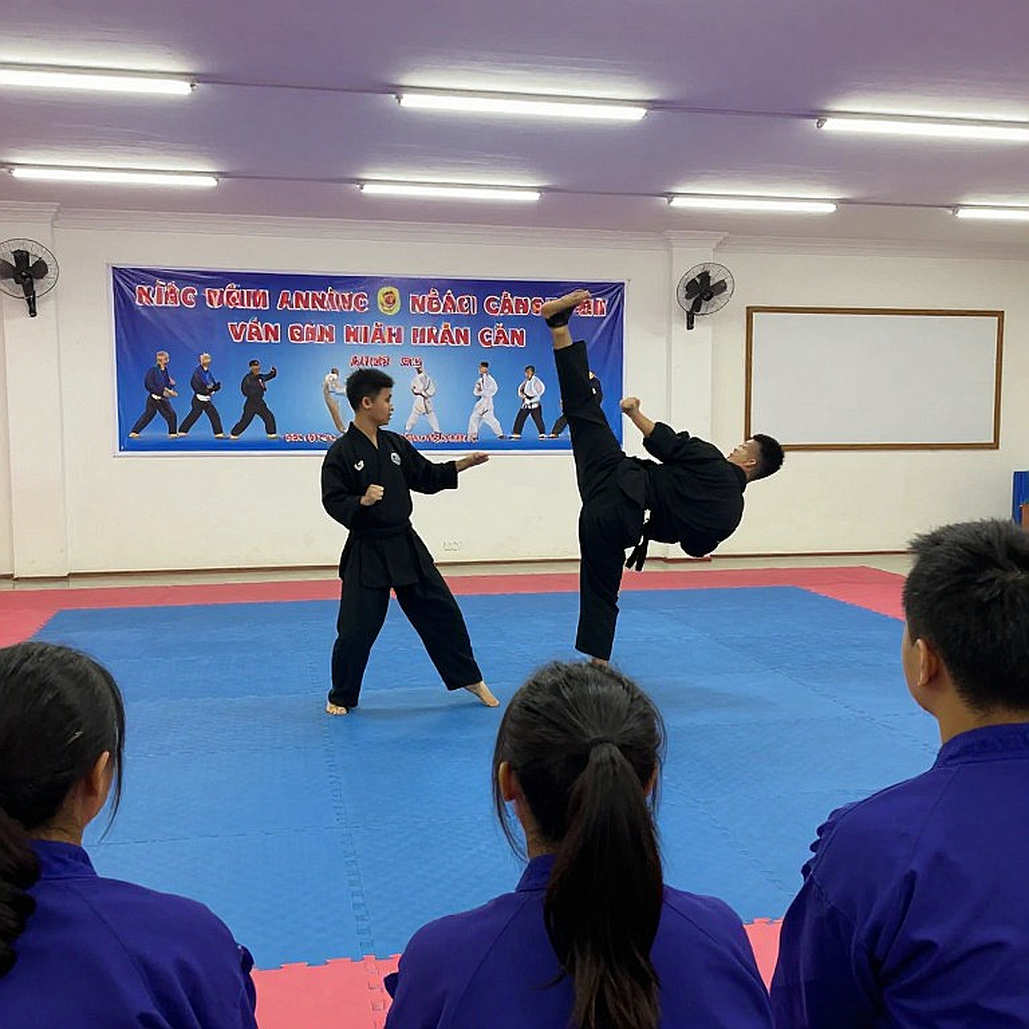
Placing Vietnam in the wider picture, our position is fairly clear. South Korea dominates with 17 gold medals. Vietnam has 3 golds, tied fourth with Iran. The Vietnamese delegation brought 39 athletes and 11 coaches, including a core of U50 veterans: Chau Tuyet Van, Nguyen Thi Le Kim, Lien Thi Tuyet Mai, Nguyen Thien Phung, Le Thanh Trung and Nguyen Van Truong. Chau Tuyet Van carries two recognized-poomsae events, the women's individual and the women's team. This championship is also counted as a stepping stone to the 2026 Asian Games in Aichi-Nagoya, so preparation has been stretched across a long cycle: continuous training since the start of the year in Ho Chi Minh City, plus a training camp in South Korea.
Vietnam's poomsae journey, counted from the 2026 marker when the discipline began to be organised systematically at home, has never seen a squad this experienced.
The first thing to notice is that Vietnam's model of achievement is collective, not individual. Team and pair events reward synchronisation, precision and training discipline, which matches the strength of a tightly organised sporting system. Individual events demand squad depth, where South Korea, the United States and Chinese Taipei are superior. Vietnam's realistic gold window therefore lies in the team events, not in the overall race.
Within that squad, Chau Tuyet Van is the load-bearing pillar. She competes in two recognized-poomsae events, meaning the load and the pressure fall on one person. If she holds her form, the team's gold haul is likely to follow. Yet for that very reason the team depends on an individual, a point rarely mentioned when people look only at the medal table.
Another notable detail lies in the squad structure. Six U50 veterans are spread across five events, meaning significant overlap in the competition schedule. For a discipline scored routine by routine, a compressed schedule can wear down stamina and focus across the competition days. Alongside them runs the freestyle youth line, notably the U30 pair of Chau Ngoc Tuyet Sang and Nguyen Xuan Thanh, prepared for the 2026 Asian Games cycle. It is a healthy succession signal, but it also shows the team running at two speeds: recognized-poomsae veterans and a freestyle youth line.
The freestyle team event has been a proven vein of gold. In return, its acrobatic nature makes the peak window shorter and the risk of joint injury markedly higher than in recognized poomsae. Thorough preparation, including year-round training and an overseas camp, reduces fitness risk but cannot erase the structural features of the discipline.
I see what lies behind the scoreboard, and I have to live with it. The story of collective strength sounds safe, and perhaps that is why it pleases the majority. But it can also mask a large gap: depth in the individual events. When the U50 veterans reach the final stretch of their careers, the succession question will surface faster than people think.
Then there is the judging problem. Poomsae is a subjectively scored discipline, where accuracy and presentation are decided by human judges. The nationality composition of the panel can amplify home advantage, and this championship is held in Chuncheon, South Korea. In other words, Vietnam's margin in closely judged events is thinner than the shine of the medals suggests.
Nor should we forget a paradox: a model built on experience is both a strength and a blind spot. It wins through maturity, but that very maturity makes it hard for the team to see the day it must renew. In the stands, fans celebrate the team golds while few notice they are woven by a group of people already near the end of the competitive road.
The true measure of Vietnamese poomsae at this championship is not the medal count, but whether the team golds can be converted into individual depth before the 2026 Asian Games. Poomsae is a discipline that rewards patience and maturity, so the handover must begin now, not on the day the veterans take their final standing pose.